
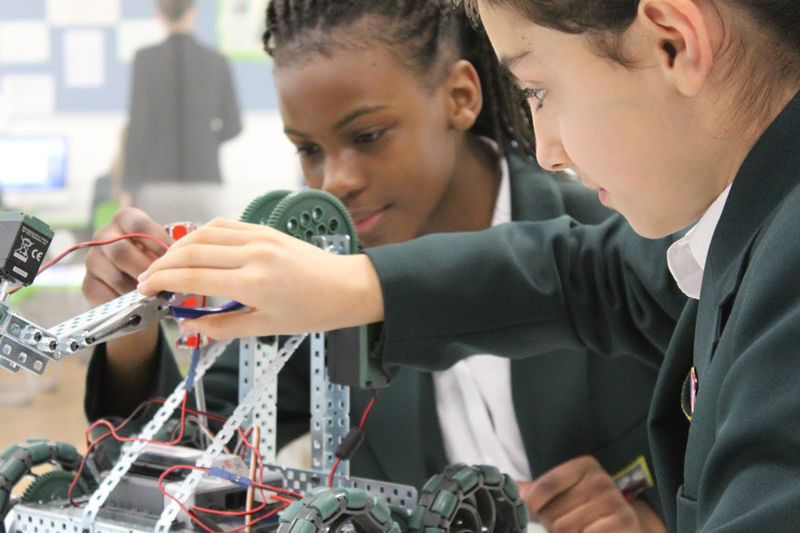
“As soon as the girls enter The Studio they light up, are happy and highly motivated to learn. The learning surfaces on the bite tables are brilliant as students are definitely more willing to share their ideas, knowing they can easily rub anything out and improve upon their first attempts.”
Lisa Peirce, Head of Computing
Why the focus on STEM?
To put the challenge into context, the national shortage of STEM skills means UK businesses in technology, engineering, manufacturing and construction are struggling to fill jobs. This makes it hard for these companies to meet demand, let alone grow, which is bad news for the economy. Look closer and you’ll find that only 13% of workers in STEM jobs are women, a mere 4% of apprenticeships in engineering and manufacturing are filled by women and a vanishingly small 1% of parents consider engineering as a possible future career for their daughters. Even girls who attain A*s at GSCE in science and maths tend not to pursue those subjects at A-level.
A room that would empower
A lot of this reluctance to don a lab coat or hard hat is down to confidence. It may even be as simple as not realising these jobs are an option. Mary Andersen, Business Manager at The Holy Cross School knew she needed a room that blew these preconceptions out of the water and empowered Holy Cross students.
“An inspirational space”
“We wanted an inspirational space that would enable students to see themselves as capable of achieving in technology,” she explains. “Somewhere that would build confidence and make them want to have a go. Students are affected by their environment. If you’re in a space that is inspiring, fun, attractive, comfortable, hi-tech and cool, you will feel differently than if you’re simply sat in a row of a traditional classroom. Spaceoasis and I were completely aligned philosophically in that we both wanted to remove barriers to learning and to use the learning environment to challenge traditional preconceptions. The input from Spaceoasis was really valuable and the quality of the furniture is excellent, it’s definitely built to last.”

From ‘Room 7’ to to the Future Tech Learning Studio
Prior to its transformation, room 7 was, in Mary’s words, ‘the least attractive room in the school’ but, with windows along two sides overlooking a tree-lined courtyard, it had potential. The school has an eclectic mix of architecture with modern teaching blocks situated behind the original convent buildings, in a physical representation of the progress of the school which began with just five pupils when it was established in 1931.
A consultative and collaborative design process
Throughout the design process teachers and students were consulted to establish their requirements and preferences and to try out different furniture options. Working with Spaceoasis, Mary and her colleagues designed an agile room that can accommodate up to 45 students working in different areas, although an ordinary lesson will have 30 or less. Specialists have been brought in to teach robotics and engineering, reflecting the school’s holistic investment in STEM subjects that goes beyond the room itself. Fully timetabled, the room is used for teaching maths, science, robotics, electronics and computing and for school enrichment clubs.

A closer look at the Future Learning Technology Studio and its furniture
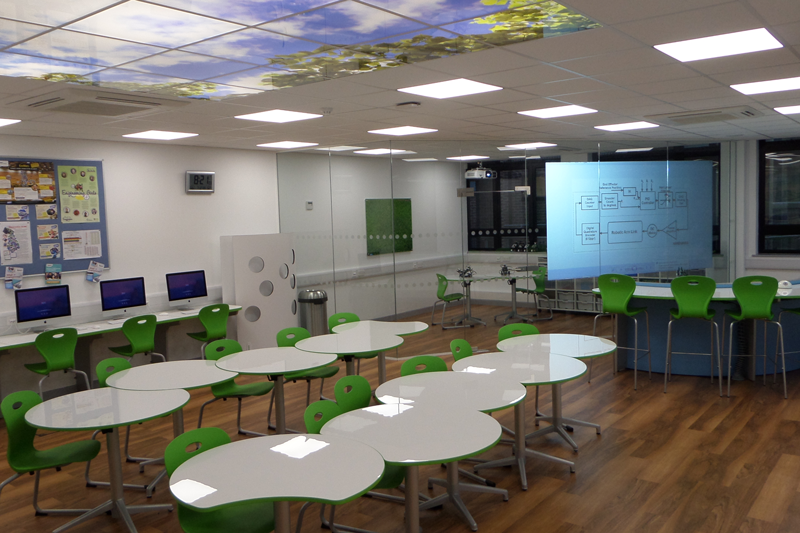
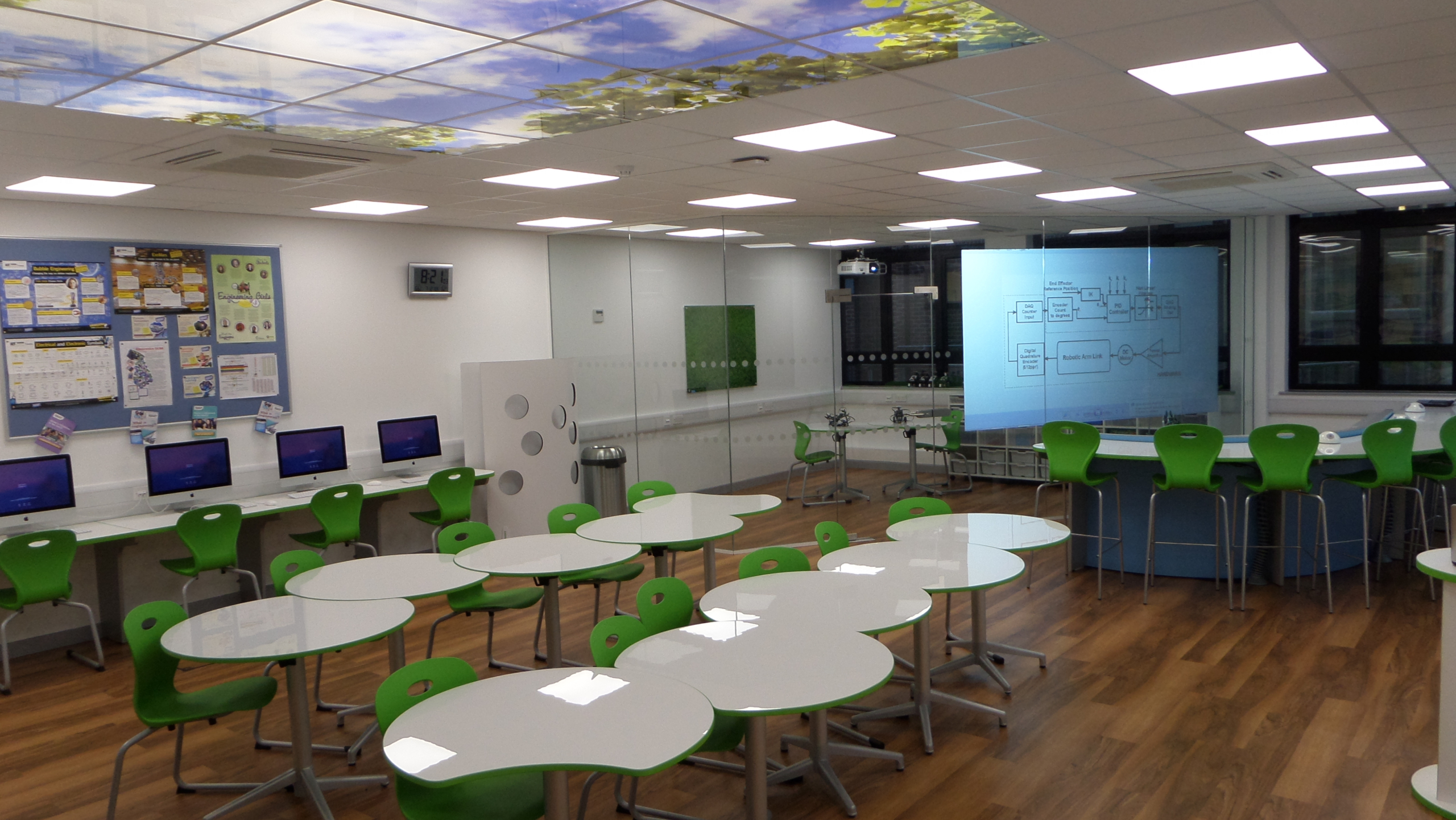
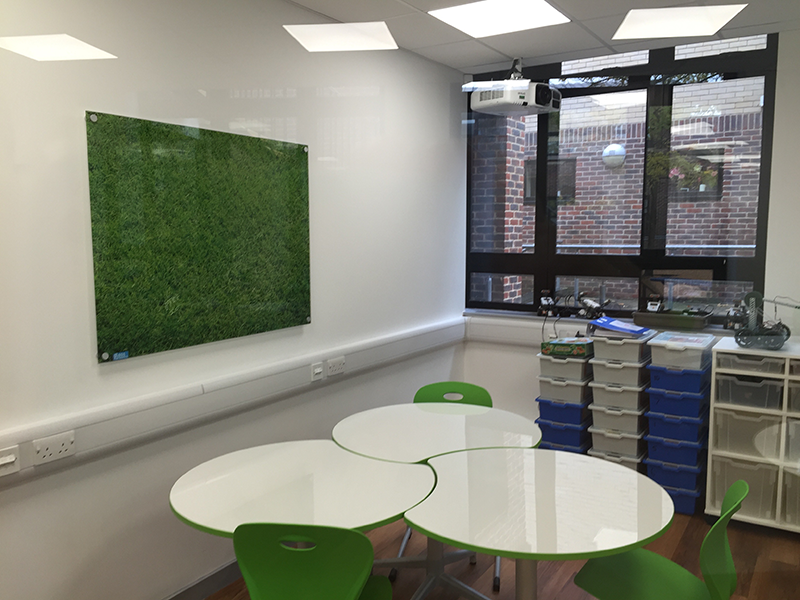
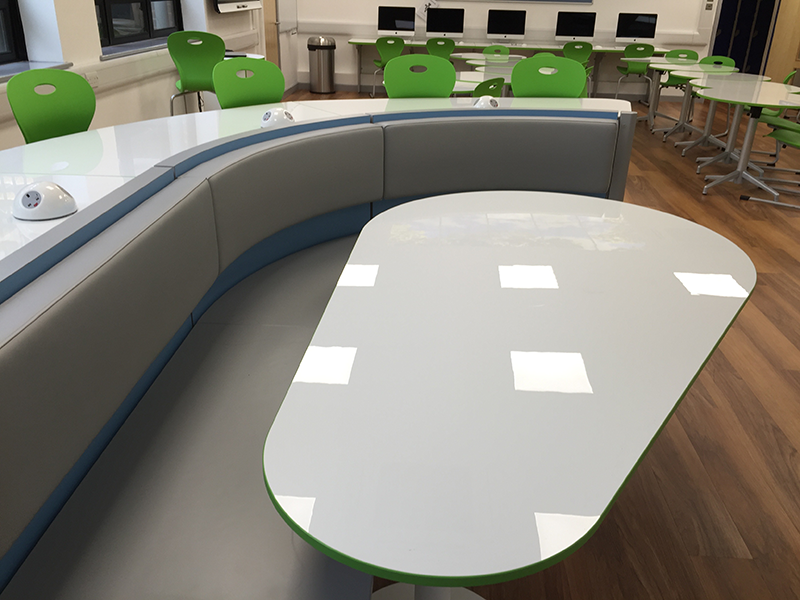
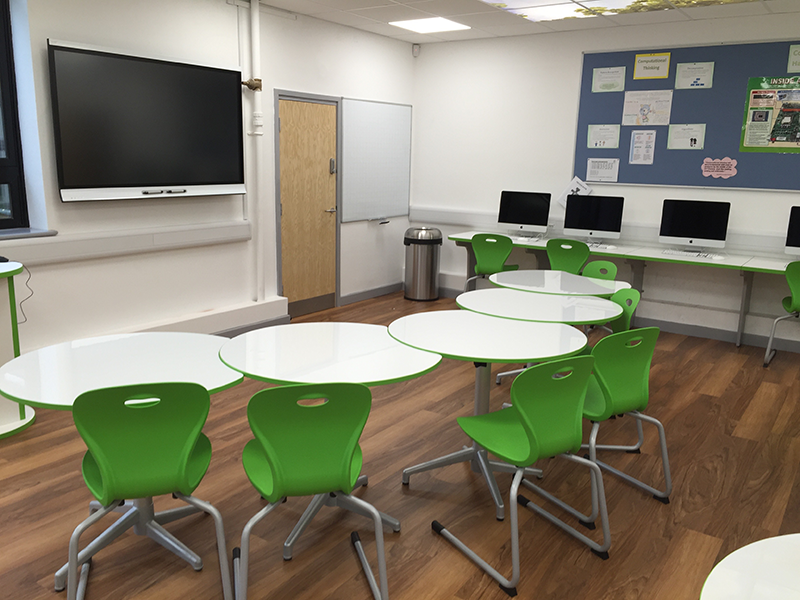
- Mobile Bite tables with dry-wipe writable hinged surfaces that flip up 90º so students can share their work, coupled with lime green reverse cantilever ergonomic chairs, chosen by the students. The Bite tables are edged in lime green, which is the room’s accent colour, chosen to mirror the leaves of the trees in the courtyard outside.
- Fixed benching around two sides of the room accommodates Mac computers
- A mobile teacher station that accommodates the teacher’s laptop and possibly a cup of coffee but not much else, deliberately omitting the traditional teacher’s desk to eliminate clutter and encourage fresh thinking. A flat screen TV is used to display what’s on the teacher’s laptop or to stream online content.
Multiple points of focus
- A large elliptical table edged in green with a writable surface, with curved bench seating around one side, is flanked by a standing-height bench with integrated power points. At the side of the elliptical table is a second teacher station to encourage variety in points of focus.
- A separate, soundproofed robotics studio, also used for A-level maths group work, houses more Bite tables and a glass writing board which looks like bright green grass.
- In keeping with the blue sky thinking this room is designed to encourage, virtual skylights created with illuminated sky panels in the ceiling lend a feeling of space and of limitless possibilities.
“You can move the furniture around and that’s instantly empowering”
“You can move the furniture around and that’s instantly empowering because you can be flexible,” said Mary. “Each teacher chooses how they want to use the room. Students and teachers are encouraged to move around too, which is energising – I don’t think sitting is our natural position. The write on- wipe off table surfaces are fantastic because it encourages the girls to try. If it goes wrong it can easily be rubbed out, ready to start over and if it’s brilliant you can take a picture and add it to your photo stream.”
“It’s a special place that makes students and teachers feel valued”
Since the studio opened in September 2015 it has been in constant use and students peering in the windows of the Future Tech Learning Studio are keen to get involved. “Because they were involved throughout the design process, the teachers have fully embraced The Studio and they love teaching in there,” explains Mary. “The reaction from the girls is always ‘wow’ when they first go in. It’s a special place that makes students and teachers feel valued because we’re investing in them, it’s somewhere they can achieve something special.”
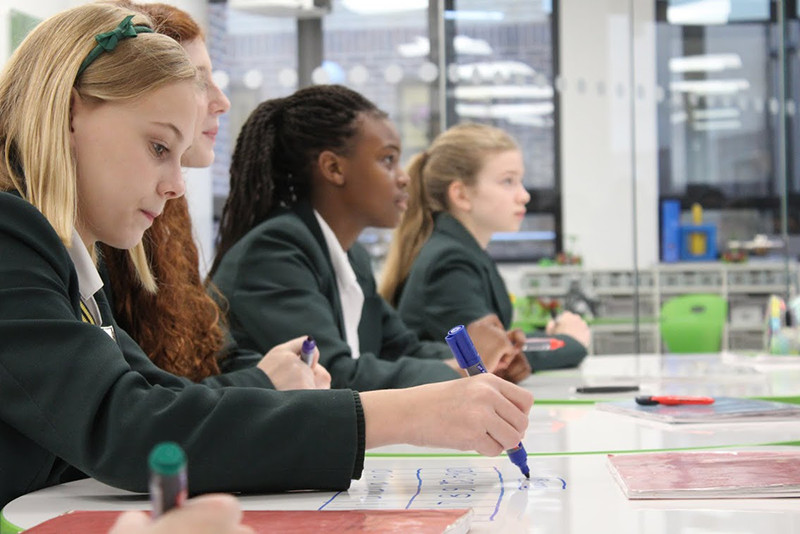

“As soon as the girls enter The Studio they light up, are happy and highly motivated to learn”
“As soon as the girls enter The Studio they light up, are happy and highly motivated to learn. The learning surfaces on the bite tables are brilliant as students are definitely more willing to share their ideas, knowing they can easily rub anything out and improve upon their first attempts.”
A Year 11 robotics student agreed, saying “I feel like anything is achievable here. It’s a really cool, high tech environment. I now plan to become a robotics engineer.” An enthusiastic Year 7 GCSE electronics student shared that “…instead of just looking at an object and taking it at face value I now think about what’s happening inside and how it actually works.”
It will be some time before we know if significant numbers of the Holy Cross girls go on to a career in STEM but for now, it’s mission accomplished!